Why your closest DNA match might not be your closest cousin
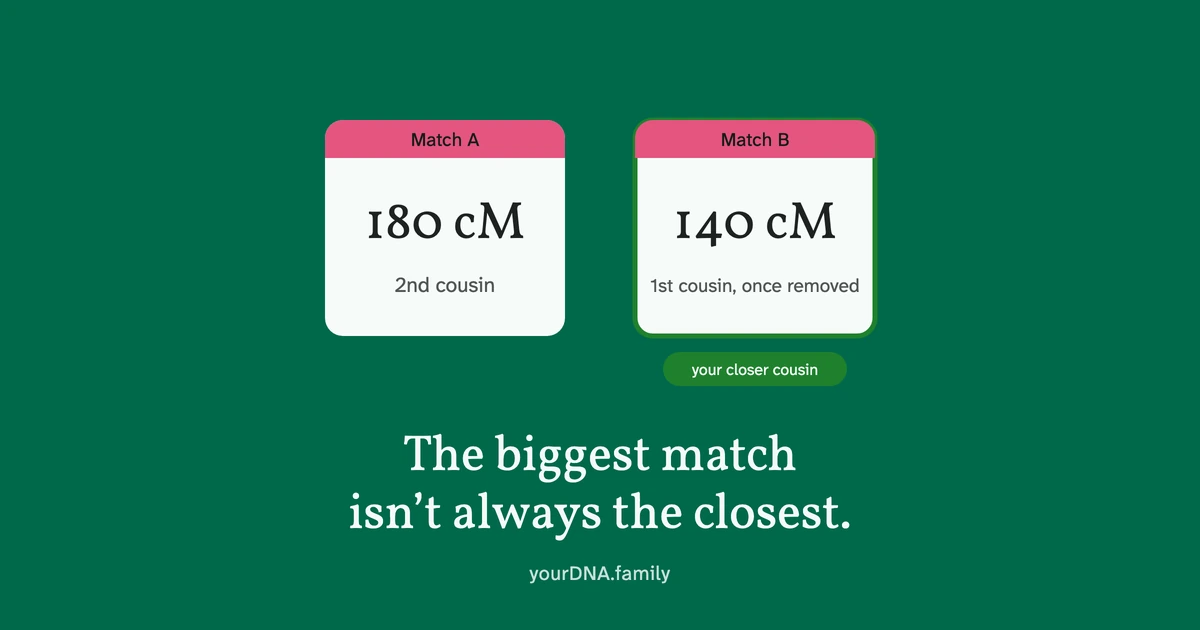
You open your match list and there it is, near the top: a stranger sharing 180 centimorgans with you. Below them, someone sharing 140. The instinct, after years of paper trails, is to treat the bigger number as the closer relative, and to chase the 180 first.
That instinct will sometimes walk you straight into a wall. The match with the most shared DNA is not always your closest cousin. Knowing why is the difference between a branch that clicks into place and an afternoon spent confirming the wrong link.
Shared DNA is a measurement, not a verdict
A centimorgan (cM) measures how much DNA you and a match inherited from the same ancestor: the same physical stretches, passed down intact. The more recent your common ancestor, the more you tend to share. Tend to. That qualifier is the whole problem.
DNA does not pass down in tidy halves of named branches. Each generation, a parent hands on roughly half of what they carry, but which half is reshuffled at random, in a process called recombination. You received about 50% of each parent's DNA, though not the same 50% your sibling received. Run that shuffle across four or five generations and the amount any two cousins share becomes a range, not a fixed figure.
The ranges are wide, and they overlap. A second cousin might share anywhere from around 40 cM to nearly 600. A first cousin once removed, who is genealogically one step closer to you, might share as little as 100. Sit those two ranges side by side and you can see the trap. A more distant cousin who inherited a generous helping can easily out-measure a closer cousin who inherited a thin one.
A worked example
Say you are working two matches on the same line.
Match A shares 180 cM with you. Match B shares 140. On the number alone, A wins, and you spend your evening building A into your tree as the nearer relation.
Now trace the actual genealogy. Match A turns out to be your second cousin: you share a set of great-grandparents. Match B is your first cousin once removed, a generation closer to your shared ancestor than A is. B is, by any genealogical measure, the closer cousin. Yet B shares 40 cM less, simply because the recombination shuffle happened to leave B with a leaner inheritance and A with a fuller one.
The bigger number can be the more distant cousin
Rank by centimorgans and stop there, and you would have placed the closer cousin in the wrong spot on your tree, or missed the link entirely. The number pointed one way; the genealogy pointed another. Both readings came from the same honest data.
Why this bites hardest on the branches you care about
The overlap problem grows as you move outward, and the branches you are still trying to resolve are almost always the outer ones. Close in, the figures are forgiving: a true first cousin shares so much DNA that no third cousin will ever overtake them. But out at the second, third, and fourth cousin range, exactly where most brickwalls live, the ranges pile on top of one another, and a single number can no longer tell you who sits where.
This is also why a half-relationship can masquerade as a full one, and why the "predicted relationship" labels on the big testing sites are estimates built from averages. They are a reasonable starting guess, not a finding.
When the number carries more weight
For some readers, the number beside a match is not a puzzle to enjoy solving but a possible parent or sibling, the answer to a question carried for many years. The same science applies, and it matters all the more here: a very high cM figure points firmly to a close relationship, yet a single mid-range figure can fit a half-sibling, a grandparent, or an aunt or uncle equally well, and only further work tells them apart. If that is the search you are on, the care that keeps a genealogist from the wrong branch is the same care that protects you from a wrong conclusion.
What actually resolves the ambiguity
A single shared number between two people will only ever take you so far, because it cannot tell you where on your chromosomes the sharing sits, or who else shares that same stretch. That is the missing piece. The way genealogists have always broken this open is triangulation: finding three or more people who all share the same segment of DNA, then tracing that shared segment back to one common ancestor. When three matches overlap on the same stretch and the paper trail agrees, you have something far sturdier than a ranked list. You have a confirmed line.
Done by hand, triangulation is slow, careful work: exporting segment data, lining up start and stop positions, cross-checking who overlaps whom. It is the kind of task that has had people wrestling with GEDmatch's manual tools for hours.
This is the part Your DNA Family takes off your hands. It compares your matches pairwise, segment by segment, down to an 8 cM floor, and gathers the people who share the same stretches into a triangulation group, then checks that group against the common ancestors already in your tree. The result arrives as a card on your Puzzle. Not "here is a big number", but "these people share this segment, and here is the ancestor they point to." You still make the call. The sorting, lining up, and cross-checking is simply already done.
In the worked example above, triangulation is what tells you the truth the centimorgans hid. Match B overlaps with two other relatives on a segment that traces to the great-grandparent one generation nearer to you, placing B exactly where the raw number said they did not belong.
The takeaway for your next session
Treat shared cM as a strong hint and a poor verdict. It tells you a match is worth your attention. It does not tell you, on its own, how that match fits. Before you commit a cousin to your tree on the strength of a number, ask the question the number cannot answer: who else shares this same segment, and where does it lead?
Answer that, and the match stops being a guess and becomes a branch you can trust.
Your DNA Family builds your triangulation groups for you and links them to the ancestors already in your tree. See how it works.
Create your free account