DNA Triangulation, Explained: How Three Cousins Confirm One Ancestor
You have a match you are fairly sure belongs on your mother's side. The shared centimorgans are in the right range, the surname feels familiar, and yet you cannot say, with the confidence you would put in writing, which ancestor connects you. One match, on its own, almost never settles it.
Three matches can. When three relatives all share the same physical stretch of DNA, and that stretch traces back to a single couple in your tree, you no longer have a guess. You have a confirmed line. That is triangulation, and it is the technique that turns a promising match into a branch you can actually trust.
This guide explains what triangulation is, walks through a worked example with three cousins, and shows you the part that has traditionally eaten whole evenings, along with how that part is now done for you.
What a triangulation group actually is
A triangulation group is three or more people who all share the same segment of DNA, in the same place, inherited from the same common ancestor.
The two conditions both matter. It is not enough that three people appear on each other's match lists. They have to overlap on the same stretch of one chromosome, and that stretch has to be large enough to be real rather than coincidental. The segments need not begin and end at exactly the same point; what counts is the shared length they all cover. Across this platform the floor for a segment to count is 8 centimorgans (cM); below that, shared DNA is too likely to be a chance lookalike to build a conclusion on. Three people overlapping on a genuine segment of, say, 22 cM are sharing it because they all descend from whoever first carried it.
This is the distinction that trips up most researchers, because a shared-matches list can look like triangulation until you examine what it actually proves.
Triangulation group versus "shared matches"
A shared matches list, the kind you have probably worked with, shows the people who match both you and your match. That is a useful hint, but it is not triangulation. It only tells you these people are connected somehow. It does not tell you they share the same stretch of DNA, and two people can sit on that list while descending from completely different branches of your tree.
Triangulation is the extra step: confirming that the group shares one specific segment and that everyone in it matches everyone else on that segment. Done by hand, that means reading off each person's segment positions, finding where they overlap, and cross-checking every pair, the kind of slow, one-position-at-a-time work that GEDmatch is built for. It is the reason a single confirmation can eat an evening, and it is the gap this technique exists to close.
A shared-matches list is not a triangulation group
Shared matches = they connect to you. Triangulation = they connect to each other, on one segment.
If you have ever ranked your matches purely by their shared-cM number and felt unsure, it is worth knowing that the same shared number can point at more than one cousin. Triangulation is what resolves that ambiguity, because it adds the two things a single number cannot give you: where the sharing sits, and who else shares it.
Three cousins, one ancestor: a worked example
Say you are trying to confirm your connection to a couple two generations above your grandparents, your great-great-grandparents, William and Mary Howe.
You have three matches you suspect descend from them:
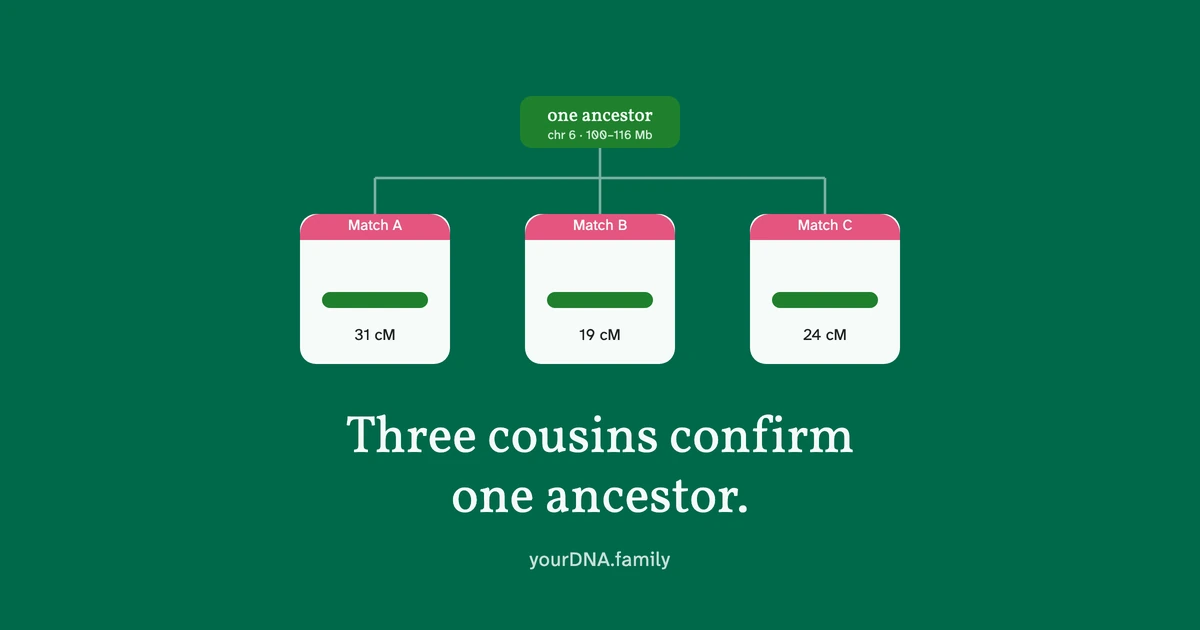
- Match A shares a 31 cM segment with you on chromosome 6, from roughly position 96 Mb to 117 Mb.
- Match B shares 19 cM with you, and her segment sits on chromosome 6, from position 100 Mb to 116 Mb.
- Match C shares 24 cM, his segment on chromosome 6, from position 98 Mb to 118 Mb.
Those positions are physical locations on the chromosome, measured in megabases (Mb); the segment sizes beside them are genetic distances, measured in centimorgans (cM). They are two different rulers, which is why a longer Mb span and a larger cM figure do not have to line up exactly.
Where the three segments overlap on chromosome 6
Lay those three side by side and the overlap is unmistakable. All three share the stretch of chromosome 6 from position 100 Mb to 116 Mb with you and, crucially, with each other. That is the test that matters: not just that each one matches you there, but that they all match one another on the same ground.
Now you check the paper trail. Match A descends from William and Mary through their son James. Match B descends through their daughter Eliza. Match C descends through another son, Thomas. Three different children, three different lines, all carrying the same piece of chromosome 6 down to the present day. The only place that segment can have come from is William or Mary themselves.
One couple, three lines, one shared segment
That is a triangulation group. The segment is confirmed, the line is confirmed, and you can write it into your tree with real confidence. One match was a hypothesis. Three matching each other on the same segment is a finding.
One caution before you write it down. Size matters as much as the overlap itself. A segment close to the 8 cM floor, in the rough range of 8 to 15 cM, is intrinsically less trustworthy than a larger one, because short stretches of DNA can line up by chance even when no recent ancestor connects two people. The 19 to 31 cM segments in this example are robust; segments near the floor call for more caution. Two other situations call for the same care: families with endogamy, where the same ancestors recur on many lines, and a few well-known "pile-up" regions of the genome where large numbers of unrelated people share DNA. In all of these, segments can overlap without pointing to a single recent ancestor, which can produce a false group. When any of them is in play, treat the triangulation as strong evidence to corroborate with a second shared segment or an independent documented line, rather than a closed case.
The slow part, and who does it now
Everything in that example is sound. The trouble is the doing of it.
By hand, you would export segment data for every match, read off start and stop positions one at a time, hunt for the overlaps, and then cross-check that each person matches every other person in the group rather than just matching you. Miss one cross-check and you can mistake two unrelated lines for a group. It is careful, slow, position-by-position work, and it is exactly the GEDmatch grind that has people closing the laptop more tired than when they opened it.
This is the work Your DNA Family takes off your hands. You upload your raw DNA file, the same export you already have from Ancestry, 23andMe or MyHeritage, and it compares your matches pairwise, segment by segment, down to that 8 cM floor. When it finds people who overlap on the same stretch, it gathers them into a triangulation group automatically and checks that group against the common ancestors already in your tree, which it can read from a GEDCOM file you import.
The result arrives as a card on your Puzzle, the page where your findings collect. A Possible Triangulation card when it spots an overlap worth your eye; a New TG card when a group comes together. You are not lining up positions in a spreadsheet. You are looking at "these people share this segment, and here is the ancestor they point to," and deciding whether you agree. The judgement stays yours. The sorting, lining up, and cross-checking is simply already done.
Want to see the technique run on your own matches rather than a worked example? You can upload a file and watch the Puzzle build a group. It is free to use today.
When the number means more than a branch
For most readers, a match is a satisfying puzzle. For some, the number beside a match is a possible parent or sibling, the answer to a question carried for many years. The science is the same, and the care matters more. A parent shares around half your DNA and is unmistakable, but a single mid-range figure can fit a half-sibling, a grandparent, or an aunt or uncle equally well, because those relationships all share almost the same amount of DNA. Telling them apart relies on other evidence: ages and generations, the way X-chromosome DNA is passed down, and the pattern of who else shares the match. Triangulation then does its own part of the work, confirming which line the connection runs through, rather than the type of relationship. The same care that keeps a genealogist off the wrong branch is what protects you from a wrong conclusion here.
One mid-range number can fit more than one cousin
What to do with this on your next session
Triangulation is not an advanced trick reserved for the most technical researchers. It is the plain standard of proof for a DNA connection: three or more relatives sharing the same segment, traced to one ancestor. Once you hold to it, a single shared number stops being a verdict and goes back to being what it always was, a hint worth investigating.
So when you next open a match you simply cannot place, do not ask only how much DNA you share. Ask who else shares that same stretch, and where it leads. Answer that, and the match clicks into place.
If you would rather not line up segments by hand, that is the whole point of the Puzzle. You can read how the platform works, and what it costs to run on the free page, then upload your file and let it find the groups for you.
Confirm your next branch. Upload your raw DNA file, the export you already have from Ancestry, 23andMe or MyHeritage, and let the Puzzle compare your matches segment by segment and gather the ones that triangulate. You decide what to do with each group; the lining-up is done for you. It is free to use today.
Upload your DNA and start triangulating